Every few months, a new frontier model claims the throne. Enterprises scramble to evaluate it, rewrite their integrations, and migrate production workloads. The cycle repeats, and the bill grows. But the teams winning at AI in 2026 are not the ones chasing the biggest model. They are the ones who figured out that the harness, the software scaffolding around the model, is where competitive advantage actually lives.
This article breaks down what makes a good AI harness, why researchers are now building harnesses that improve themselves, and how the right harness layer lets you swap models freely without breaking your applications.
An AI harness is the complete software layer that wraps a large language model and turns it from a text generator into a working agent. It includes:
Think of the model as an engine and the harness as everything else: the transmission, the steering, the brakes, the dashboard. A great engine in a car with no steering wheel is useless. The same applies to LLMs. Tools like Claude Code, OpenAI Codex, and open-source projects like LangChain and LangGraph are all harnesses at their core.
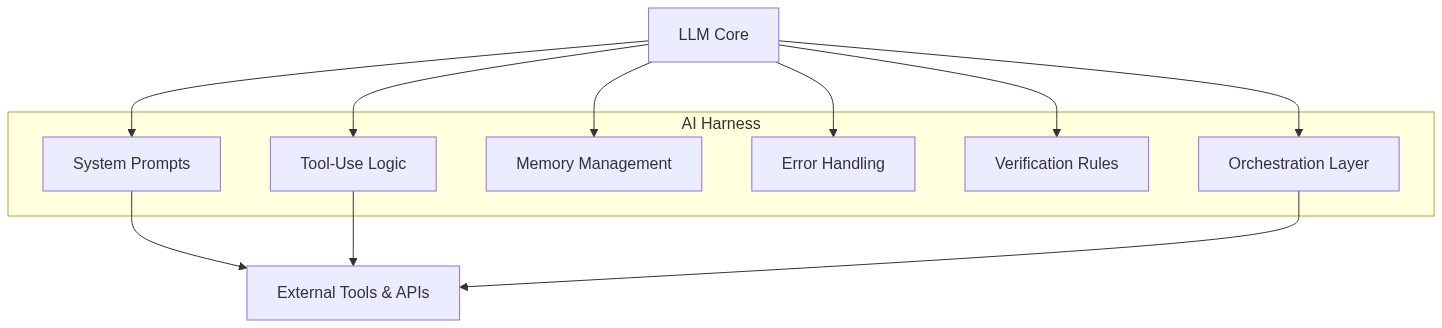
The harness is the middleware between the model and the real world. It decides which tool to call, how to format the request, what to do when the call fails, and how to verify the result. Without a harness, an LLM is a chatbot. With a good harness, it is an agent that can ship code, manage infrastructure, and execute business logic.
Today, engineers build harnesses by hand. They write system prompts, wire up tool definitions, implement retry logic, and hard-code edge case handling. This approach works for a prototype. It breaks down at scale.
The core problem is brittleness. Swap the underlying model, say upgrade from GPT to Claude, and your whole application architecture can break. Different models format tool calls differently. They respond to prompts differently. They have different context windows, different token limits, and different failure modes. Every model swap becomes a mini-migration project.
Here is what typically goes wrong when teams manually engineer harnesses:
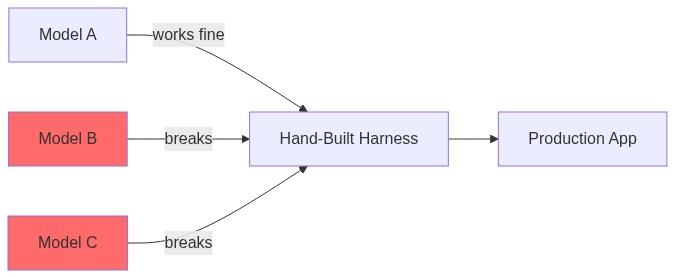
Every edge case requires a human to debug and rewrite logic. It is slow, rigid, and does not scale across model updates. The result is that teams get locked into a single model provider. They tolerate rising costs and degrading performance because switching is too expensive.
Researchers at Shanghai AI Lab introduced a framework called Self-Harness. The core idea is radical: what if the AI agent rewrites its own operating rules without human intervention or a stronger teacher model?
The Self-Harness framework works in a three-stage loop:

This creates a self-reinforcing improvement loop. The agent gets better at its job autonomously over time. No human needs to manually debug and rewrite logic. No stronger model is needed as a teacher. The harness evolves to fit the tasks it is given.
The implications are significant. If the harness can improve itself, then the model underneath becomes less critical. A smaller, cheaper model with a self-optimizing harness can match the performance of a larger, more expensive model with a static harness.
The Shanghai AI Lab results are striking. Their experiments showed that lightweight and cheaper models equipped with an optimized self-harness achieved up to a 60% performance boost on benchmark tasks. These are not incremental gains. They are the kind of improvement that changes the economics of AI deployment.
The key insight is that many model failures are not caused by the model lacking capability. They are caused by the harness failing to guide the model effectively. A model that produces a wrong answer might have the knowledge to produce the right one. The harness just did not steer it correctly.
| Configuration | Model Cost | Harness Type | Performance |
|---|---|---|---|
| Large frontier model + static harness | $$$$ | Manual | Baseline |
| Large frontier model + self-harness | $$$$ | Self-improving | +15-25% |
| Small model + static harness | $ | Manual | -20-30% vs baseline |
| Small model + self-harness | $ | Self-improving | +50-60% vs small baseline |

This flips the conventional AI strategy on its head. Instead of spending more on bigger models, you invest in better harness engineering. The harness is a one-time investment that compounds. The model is a recurring cost that scales with usage.
For enterprises running AI workloads at scale, the math is compelling. Consider a company processing one million agent interactions per month:
Option B delivers higher quality at one-tenth the cost. The harness investment pays for itself within weeks. And because the harness is model-agnostic, the company can swap models freely as pricing and capabilities evolve.
Not all harnesses are created equal. Whether you are building one in-house or adopting a platform, here are the dimensions to evaluate:

A good harness scores well across all eight dimensions. A great harness is one you can improve without rewriting from scratch.
After auditing dozens of enterprise AI deployments, certain failure modes appear repeatedly. Here are the anti-patterns to avoid:
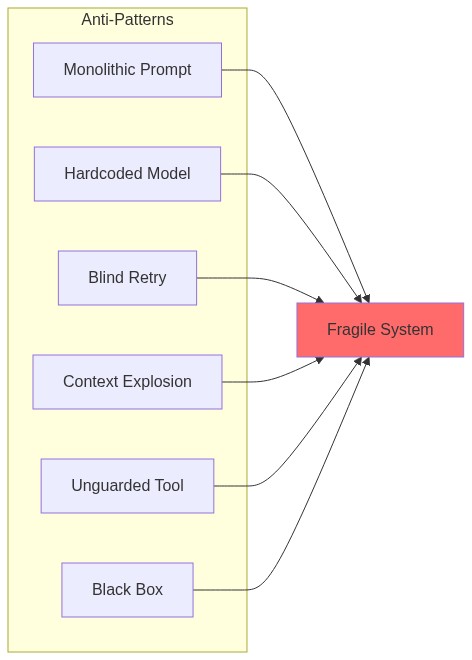
Each of these anti-patterns shares a root cause: the team treated the harness as an afterthought. They focused on the model and threw together a harness to make it work. The harness needs to be a first-class engineering concern, with the same rigor you would apply to any production system.
The reflex for most teams when AI performance is lacking is to upgrade the model. This is the most expensive and least durable fix. Here is why:
| Strategy | Upfront Cost | Recurring Cost | Durability | Vendor Lock-in |
|---|---|---|---|---|
| Upgrade to bigger model | Low | Very High | Low (model deprecates) | High |
| Fine-tune current model | Medium | Medium | Medium | Medium |
| Optimize the harness | Medium-High | Low | High (compounds) | Low |
| Self-improving harness | High | Very Low | Very High (improves over time) | Very Low |

Model upgrades are a treadmill. You pay more, get a temporary boost, and then the next model comes out and you are behind again. Harness optimization is an investment that compounds. Each improvement makes every model you use better, and the improvements persist across model swaps.
Open-source model options like Llama, DeepSeek, and GLM make the case even stronger. These models can be self-hosted at a fraction of the cost of frontier APIs. But they need a good harness to match frontier model performance. The harness is what bridges the gap.
At Shakudo, we build the harness layer so you do not have to. The core principle is model-agnostic orchestration: your applications talk to a stable API, and the harness handles the complexity of routing to the right model, managing context, enforcing security, and optimizing costs.
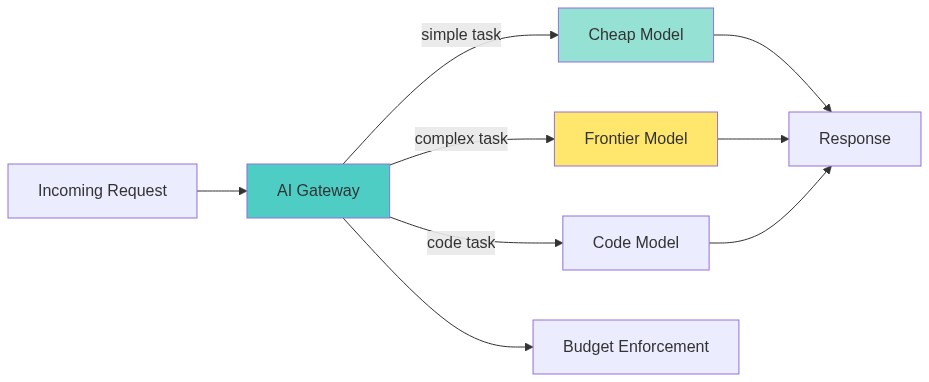
The Shakudo AI Gateway is the routing layer of this harness. It sits between your applications and any model, whether that is a frontier API like Claude or GPT, or a self-hosted open-source model like Llama or Gemini. When a new model drops, you evaluate it through the gateway and switch over with a configuration change, not a code rewrite.

Kaji, our AI coding agent, is itself an example of a sophisticated harness in action. It manages tool calls, enforces safety guardrails, maintains context across long sessions, and routes to the appropriate model based on the task complexity. The same harness principles that make Kaji effective at writing code apply to any AI agent workload.
One of the most immediate benefits of a harness-first approach is cost control. The gateway can route simple queries to cheaper models and reserve expensive frontier models for tasks that genuinely need them. This is model routing at scale, and it typically cuts inference costs by 60-80% compared to sending every request to the most expensive model.
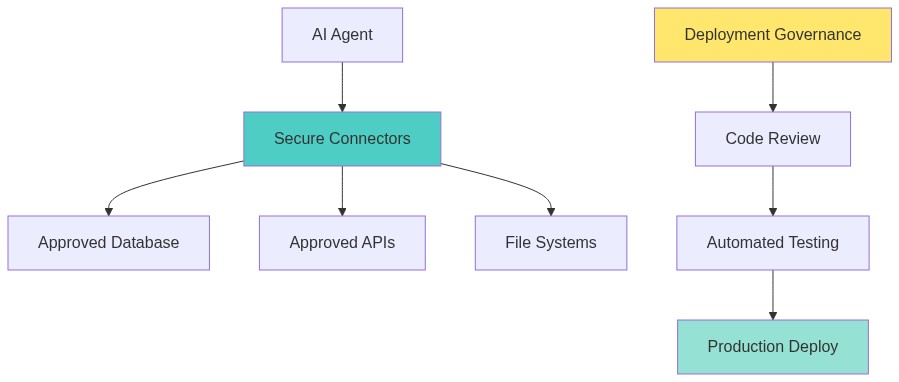
For enterprises in regulated industries, the harness also handles the governance layer. Secure connectors ensure that AI agents access data through approved, audited channels. Deployment governance ensures that vibe-coded applications go through proper review before reaching production. This is critical for critical infrastructure providers who cannot afford a single compliance failure.
Our customers see this play out in practice. Teams that adopt a harness-first approach with the Shakudo platform report faster time-to-production for AI features, lower inference costs, and the ability to switch models without disruption. Visit our customers page to see how enterprises are using this approach to deploy AI at scale.
An AI harness is the software layer that wraps a large language model and turns it into a functional agent. It includes system prompts, tool-use logic, memory management, error handling, verification rules, and orchestration. The model generates text. The harness decides what to do with that text, which tools to call, how to handle failures, and how to verify results. Without a harness, an LLM is a chat interface. With a good harness, it is an autonomous agent.
The terms overlap but have a practical distinction:
An agent harness typically includes an LLM harness as a component. The agent harness is the broader system that manages the full agent lifecycle.
Common examples include:
Each of these wraps one or more LLMs and provides the scaffolding for agentic behavior.
Building a production-grade AI harness involves several layers:
Most teams should not build all of this from scratch. Using a platform like Shakudo that provides these layers out of the box lets you focus on your application logic rather than harness infrastructure.
The best framework depends on your use case:
The key criterion is model portability. A framework that locks you into a single model provider will cost you more in the long run than one that abstracts the model layer.
The cost of an AI harness breaks down into three categories:
A managed harness platform like Shakudo AI Gateway shifts the build and operational costs to a predictable subscription, while giving you control over infrastructure costs through model routing and token budget enforcement. Most teams find this far cheaper than maintaining a custom harness, especially as the number of models and tools grows.
The AI industry has spent two years obsessing over model benchmarks. That era is ending. The research from Shanghai AI Lab confirms what practitioners have suspected: the harness, not the model, is where the performance gains and cost savings live. A self-improving harness can boost a small model's performance by 60%. A model-agnostic harness lets you swap providers without rewriting code. A secure harness lets you deploy AI agents in regulated environments without compliance risk.
The teams that win the next phase of AI adoption will be the ones who treat the harness as their core infrastructure, not as an afterthought. They will run cheaper models with smarter harnesses. They will switch models freely as the market evolves. And they will deploy agents with the confidence that comes from full observability and security boundaries.
If you are ready to stop chasing models and start investing in the layer that actually compounds, talk to us about deploying a harness-first AI infrastructure for your team.