
Every era of software engineering has been defined by a single abstraction that made the previous one look like manual labor. Assembly language made machine code writable. Compilers made assembly readable. Frameworks made compiled code reusable. APIs made frameworks composable. Each abstraction moved the developer further from the machine and closer to intent.
Loop engineering is the next and final step in that chain. It is the practice of writing autonomous control loops that drive AI agents toward a goal, replacing the manual prompt, review, correct, and reprompt cycle with code that steers itself. And it is not just another abstraction. It is the last one, because after loops, there is nothing left to abstract away. You describe the goal. The loop handles the rest.
The argument is simple. Every prior abstraction still required the developer to specify how to get from intent to outcome. You wrote the algorithm. You called the API. You wired the pipeline. Loop engineering removes that final requirement. The developer specifies what the goal is, and the loop discovers the how through iterative agent execution, verification, and stateful memory.
This article makes the case for why loop engineering is the terminal abstraction, how it changes the economics of software development, and what it means for the teams that adopt it now versus the ones that wait.
To understand why loop engineering is the last abstraction, you have to look at the pattern that brought us here. Each major leap in software engineering followed the same arc:
Here is how that arc played out across six generations:
The first programmers wrote binary. Every instruction was a numeric opcode. The bottleneck was human cognition. Assembly language introduced symbolic mnemonics, letting humans write ADD instead of 01000001. The abstraction was thin but transformative.
Assembly was readable but not portable. FORTRAN, C, and later Pascal introduced compilers that translated human readable logic into machine code for any architecture. The developer stopped thinking about registers and started thinking about algorithms.
Writing algorithms from scratch was slow. Frameworks like Rails, Django, and Spring bundled common patterns into reusable scaffolding. The developer stopped writing boilerplate and started composing conventions.
Monolithic frameworks were hard to scale. APIs and microservices decomposed applications into independent contracts. The developer stopped managing internal calls and started orchestrating external services.
APIs were composable but rigid. Each endpoint required explicit integration code. Large language models introduced prompting, where the developer described intent in natural language and the model generated the integration. The developer stopped writing glue code and started writing instructions.
Prompting was powerful but manual. Every interaction required a human to read the output, evaluate it, correct it, and reprompt. Loop engineering wraps the prompt inside a control loop that evaluates, decides, and iterates autonomously. The developer stops prompting and starts engineering the loop.
The pattern is unmistakable. Each abstraction eliminated a layer of manual translation between intent and execution. Loop engineering eliminates the final layer: the human in the loop.

Every previous abstraction made the developer faster at writing instructions. Loop engineering makes the developer stop writing instructions altogether. That is the categorical break, and it is worth examining in detail.
Traditional software engineering, even with the best frameworks and APIs, follows a fixed pipeline:
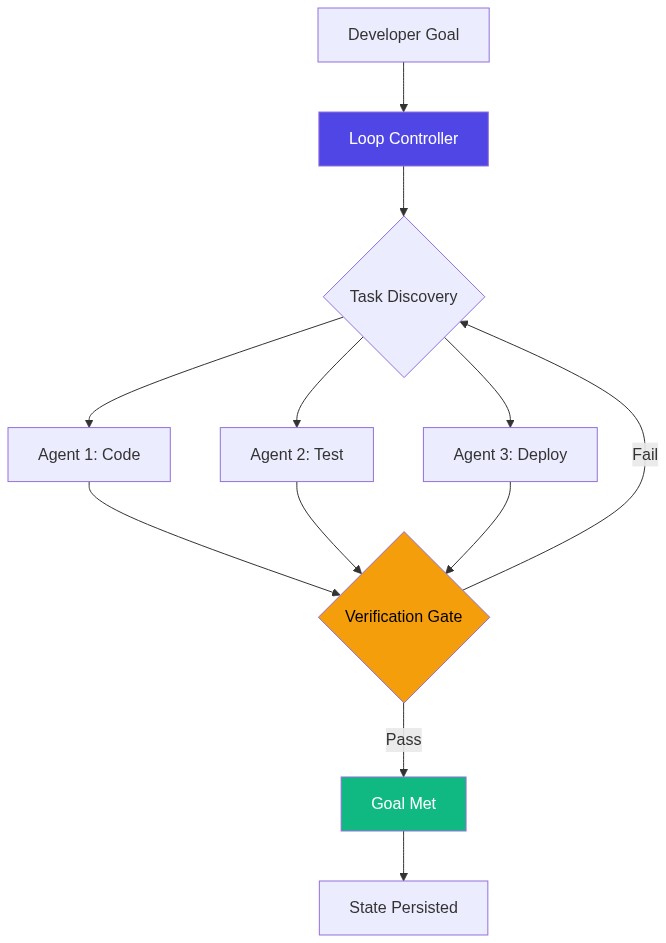
Loop engineering replaces that pipeline with a recursive loop:
The difference is not incremental. It is the difference between writing a recipe and hiring a chef. The recipe author specifies every step. The chef is given a dietary constraint, a pantry, and a deadline, and figures out the steps.
For an abstraction to be terminal, it must satisfy three conditions. Loop engineering satisfies all three:
Intent completeness. The abstraction must accept intent as its only required input. No intermediate specification of algorithm, data flow, or control structure is needed. Loop engineering takes a goal description and autonomously decomposes it into tasks.
Self correction. The abstraction must detect its own failures and recover without human intervention. Loop engineering includes verification gates, retry logic, and stateful memory that allow the loop to learn from failed attempts and try alternative approaches.
Compositional closure. The abstraction must be able to compose with itself, producing arbitrarily complex systems from the same primitive. A loop can dispatch subloops, which can dispatch subsubloops, building entire systems from a single recursive pattern.
No prior abstraction satisfies all three. Compilers require you to specify the algorithm. Frameworks require you to specify the architecture. APIs require you to specify the integration. Prompting requires you to specify the instruction. Only loop engineering accepts pure intent and returns a finished result.

The claim that loop engineering is the last abstraction rests on a simple observation. Every abstraction exists to reduce the distance between what you want and what you have to do to get it. Once that distance reaches zero, there is nothing left to abstract.
Consider the gap at each stage of the evolution:
| Abstraction Era | What You Specify | What the System Figures Out | Gap Remaining |
|---|---|---|---|
| Machine Code | Opcodes | Nothing | Everything |
| Assembly | Mnemonics | Opcode encoding | Register allocation |
| Compiled Languages | Algorithms | Register allocation, machine code | Algorithm design |
| Frameworks | Conventions | Boilerplate, patterns | Business logic |
| APIs | Integration contracts | Service communication | Integration code |
| Prompting | Natural language instructions | Text generation | Instruction refinement |
| Loop Engineering | Goals | Task decomposition, execution, verification, iteration | Zero |
The gap shrinks with each abstraction. Loop engineering closes it entirely. Once you can specify a goal and the system autonomously decomposes, executes, verifies, and iterates, there is no remaining translation layer to abstract away. The only thing left is the goal itself, and that is not software. That is intent.
A common objection is that loop engineering is just automation with a new name. It is not. Traditional automation follows a predetermined script. An automated pipeline executes steps that a human designed in advance. If a step fails, the pipeline halts and waits for human intervention.
Loop engineering is fundamentally different because the loop itself decides what to do next. It does not follow a script. It evaluates the current state, selects from a space of possible actions, executes, verifies, and adapts. The loop is not automation. It is agency.
Consider the difference in failure modes:
This distinction is what makes loop engineering terminal. Automation still requires a human to design the failure handling. Loop engineering handles failure autonomously because the loop itself is the failure handler.

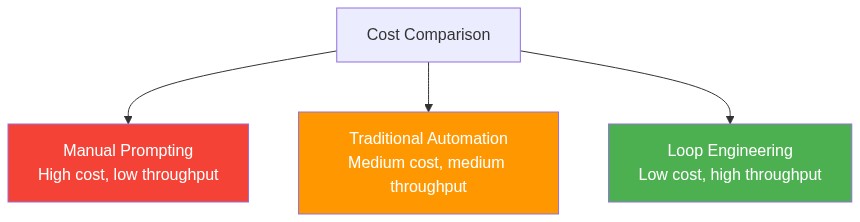
To make the contrast concrete, here is how loop engineering compares to traditional software development across the dimensions that matter to engineering teams.
| Dimension | Traditional Development | Loop Engineering |
|---|---|---|
| Primary Input | Detailed specification | Goal description |
| Execution Model | Fixed pipeline | Recursive control loop |
| Failure Handling | Manual intervention | Autonomous retry with alternatives |
| State Management | External (databases, queues) | Internal (loop memory, context persistence) |
| Scaling Approach | Add more engineers | Add more parallel loops |
| Quality Assurance | Separate QA phase | Inline verification gates |
| Time to First Result | Days to weeks | Minutes to hours |
| Maintenance Model | Patch and redeploy | Loop self corrects and persists |
| Cost Structure | Linear with complexity | Sublinear with complexity |
| Knowledge Retention | Lost on team turnover | Persisted in loop memory |
The most important row is the last one. In traditional development, institutional knowledge lives in the heads of engineers. When they leave, the knowledge leaves with them. In loop engineering, knowledge is persisted in the loop's state, memory, and verification history. The loop becomes the documentation.
Systems built with loop engineering share a set of characteristics that distinguish them from traditional software. Understanding these characteristics is essential for teams evaluating whether to adopt the approach.
Goal oriented, not instruction oriented. The system is configured with a desired outcome, not a sequence of steps. The loop determines the steps.
Stateful across sessions. The loop maintains memory of past attempts, successes, and failures. It does not start from scratch each time. This is what makes it improve over iterations.
Self verifying. Every agent action passes through a verification gate before the loop accepts it. Verification can be deterministic (test suite, linting, type checking) or semantic (evaluator agent, human review for high stakes decisions).
Parallelizable. Loops can dispatch multiple agents concurrently, each working on an independent subgoal. The loop coordinates their outputs and resolves conflicts.
Budget aware. Each loop has a compute and cost budget. When the budget is exhausted, the loop reports its progress and waits for a decision rather than running indefinitely.
Auditable. Every decision the loop makes is logged: what task it discovered, what agent it dispatched, what output was produced, whether verification passed, and what alternative it selected on failure. This creates a full audit trail.
Composable. A loop can spawn subloops. A subloop can spawn subsubloops. This recursive composition allows arbitrarily complex systems to be built from a single primitive.
Safe by default. The loop includes deterministic circuit breakers that halt execution when safety constraints are violated, regardless of what the agent recommends. These breakers cannot be overridden by the agent.
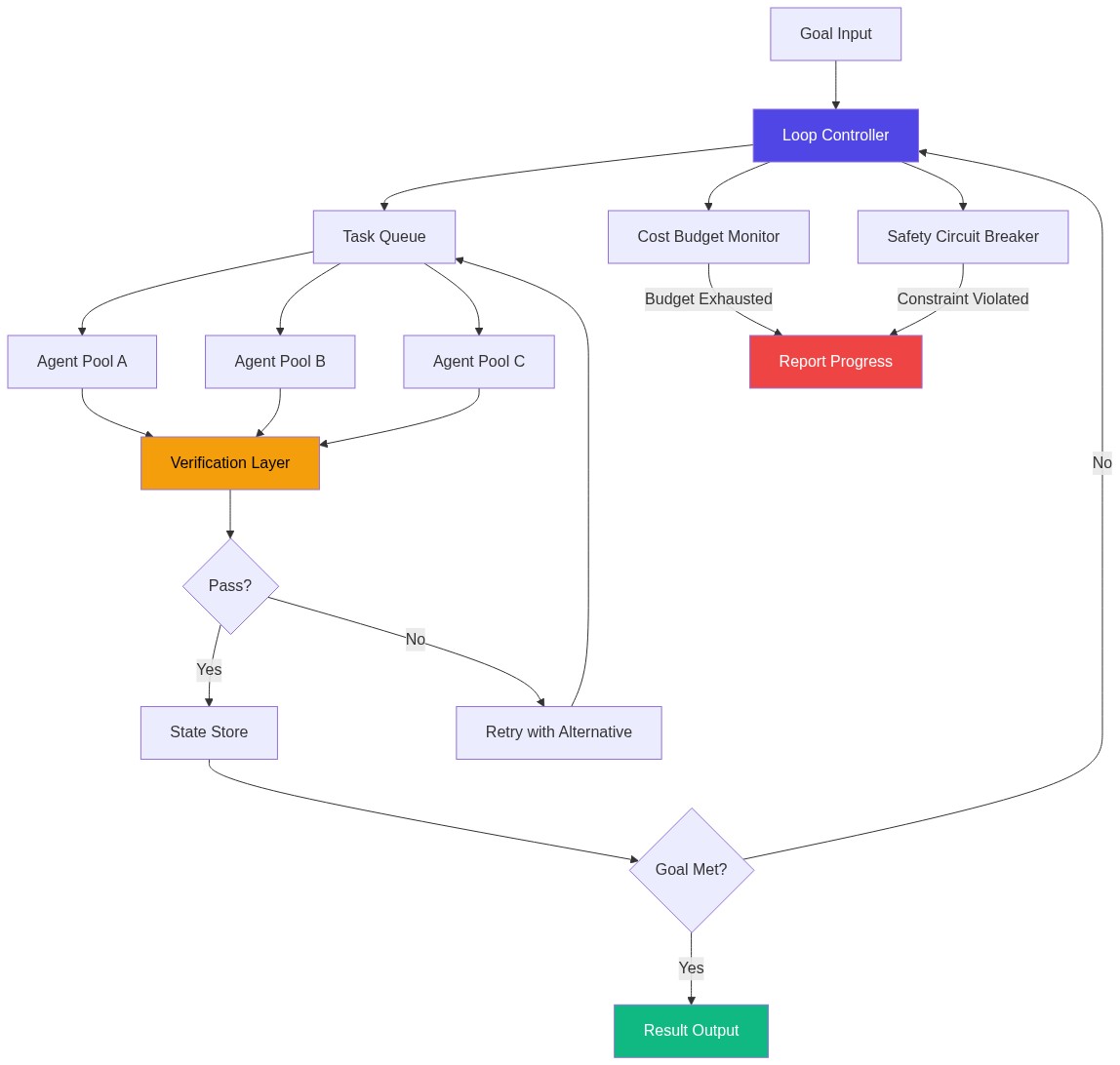
The theoretical argument for loop engineering as the terminal abstraction is compelling, but the practical question is how it actually works in production. Here is a walkthrough of a typical loop engineered workflow.
The developer writes a goal specification. This is not a user story or a ticket. It is a structured description of the desired outcome, including constraints, success criteria, and budget.
The loop controller reads the goal and decomposes it into discrete tasks. It may use an agent to analyze the codebase, identify the relevant files, and generate a task list.
The loop dispatches agents to execute each task. Some tasks run in parallel (locating files, writing tests) while others are sequential (modifying the query before updating the schema). The loop manages the dependency graph.
After each task completes, the loop runs a verification gate. For code changes, this typically includes:
If verification fails, the loop feeds the error back to the agent and retries with the failure context. If verification fails repeatedly, the loop selects an alternative approach (different agent, different strategy, or human escalation).
The loop persists state at every step. This includes the current task graph, completed tasks, failed attempts, agent outputs, and verification results. If the loop is interrupted (budget exhaustion, circuit breaker, or manual pause), it can resume from the last checkpoint without losing progress.
When all tasks are verified and the success criteria are met, the loop reports completion. The result includes the changes made, the verification results, the total cost, and a full audit trail.
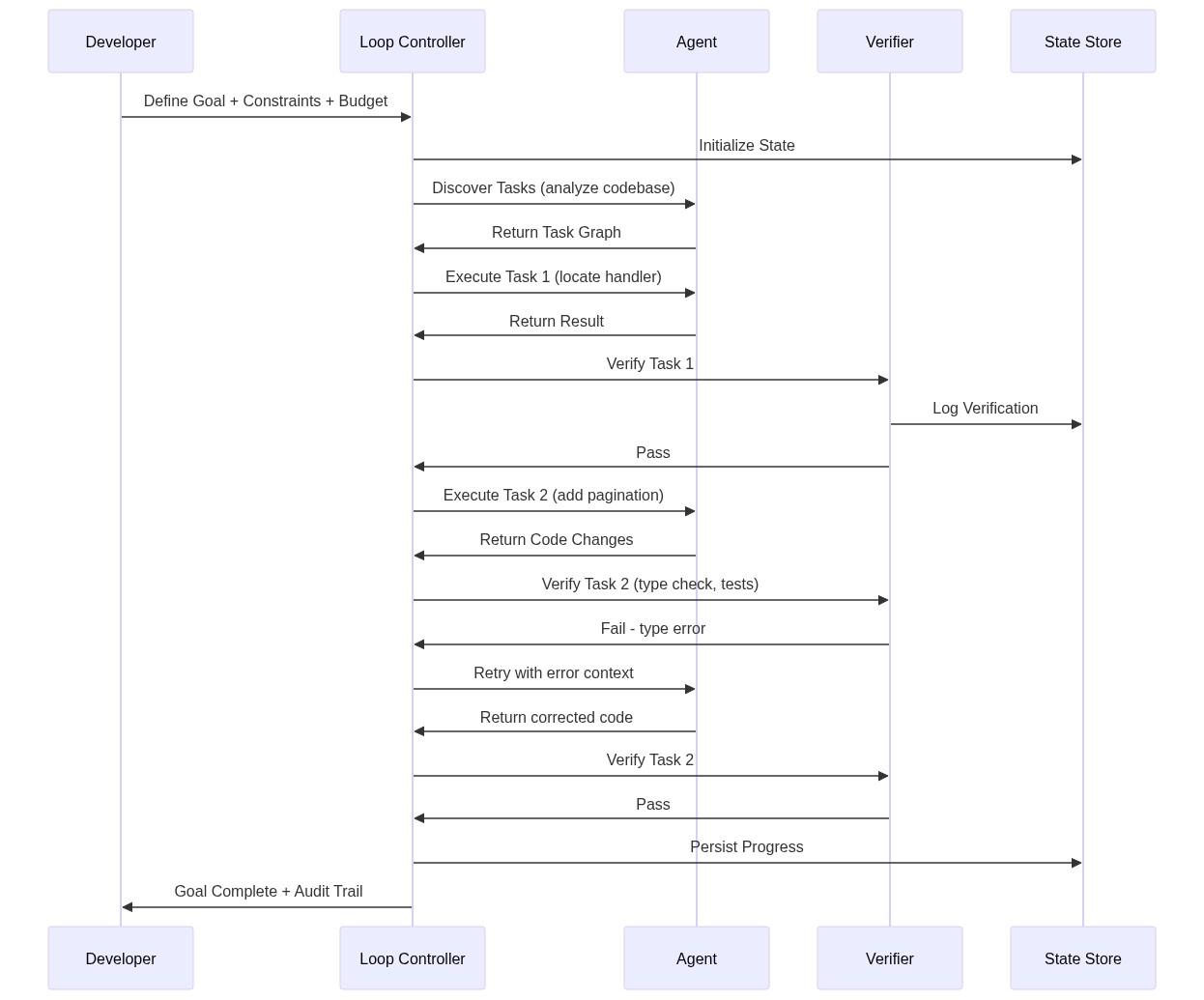
Loop engineering is not a theoretical framework waiting for adoption. It is already in production across industries. The use cases below illustrate how different sectors apply the terminal abstraction to solve problems that traditional development could not.
Financial institutions use loop engineering for regulatory compliance automation. A compliance loop continuously monitors transactions, flags anomalies, generates regulatory reports, and submits them through the appropriate channels. The loop verifies each report against regulatory schemas before submission and retries with corrections if validation fails. This replaces teams of analysts who previously reviewed transactions manually and reduces reporting latency from days to minutes.
Key applications in finance:
Healthcare organizations deploy loop engineering for clinical documentation and care plan generation. A clinical loop reads patient records, extracts relevant information, generates documentation that meets billing and compliance standards, and verifies the output against clinical coding rules. The loop includes human review gates for high stakes decisions but handles routine documentation autonomously.
Key applications in healthcare:
Manufacturing companies use loop engineering for supply chain optimization and predictive maintenance. A supply chain loop monitors inventory levels, predicts demand based on historical data and market signals, automatically places orders when thresholds are crossed, and verifies that orders meet compliance and budget constraints. The loop adapts to disruptions by selecting alternative suppliers and rerouting logistics.
Key applications in manufacturing:
Retailers apply loop engineering to dynamic pricing, content generation, and customer support. A pricing loop monitors competitor prices, demand signals, and inventory levels, then adjusts prices within guardrails set by the merchandising team. The loop verifies that every price change meets margin and competitiveness constraints before publishing.
Key applications in retail:
Technology companies are the earliest adopters of loop engineering, applying it to the software development lifecycle itself. A development loop takes a feature request, writes the code, runs the tests, fixes failures, and prepares a pull request. The loop includes code review verification gates and can escalate to human reviewers for architectural decisions. This is the use case that most directly demonstrates why loop engineering is the terminal abstraction: the software is writing the software.
Key applications in technology:

Moving from traditional development to loop engineering is not a switch. It is a phased transition that introduces loop primitives incrementally. Here is a roadmap that teams can follow.
Start by identifying workflows that are repetitive, well defined, and verifiable. These are the candidates for loop engineering. Good starting points include:
Select one workflow and wrap it in a control loop. The loop should include:
Before deploying to production, add the safety controls that make the loop trustworthy:
Once the first loop is stable, scale by running multiple loops in parallel. Each loop handles an independent workflow. Coordinate loops through shared state and dependency graphs.
The final phase is composition. Build meta loops that orchestrate subloops. A meta loop takes a high level goal, decomposes it into subgoals, and dispatches each subgoal to a specialized subloop. This is where the recursive power of loop engineering becomes visible.

Teams that succeed with loop engineering follow a set of practices that keep loops safe, effective, and cost efficient. These are the practices that separate production grade loops from experiments.
Start with verifiable goals. If you cannot define a verification gate, you are not ready to loop. Every goal must have a deterministic or semantic check that the loop can use to evaluate success.
Set aggressive budgets. Loops without budgets run forever. Set a turn limit, a wall clock limit, and a cost limit. When any limit is hit, the loop should report progress and stop.
Use deterministic breakers for safety. Do not rely on the agent to self regulate. Use deterministic code that checks safety constraints and halts the loop regardless of what the agent recommends.
Persist state aggressively. Every task, every output, every verification result should be persisted. This enables resumption after interruption and creates an audit trail.
Separate execution from verification. The agent that executes a task should not be the same agent that verifies it. Use independent verification to avoid confirmation bias.
Escalate gracefully. When a loop exhausts its budget or hits a circuit breaker, it should escalate to a human with a clear summary of what was attempted, what succeeded, and what failed.
Monitor cost per goal, not per turn. Individual agent turns are cheap. The question is whether the total cost of achieving a goal is acceptable. Track cost per completed goal, not cost per API call.
Version your loops. Treat the loop definition as code. Version it, test it, and roll back if a new version produces worse results than the previous one.
Share memory across loops. Loops that work on related problems should share a memory store. This prevents redundant discovery and allows one loop's learnings to benefit another.
Measure loop efficiency. Track the ratio of successful goals to total attempts, the average turns per goal, and the average cost per goal. These metrics tell you whether your loops are improving over time.
Shakudo provides the infrastructure that makes loop engineering practical at enterprise scale. The Shakudo platform includes the components that a production grade loop requires: an AI gateway for routing agent calls across model providers, Kaji for orchestrating agent workflows with verification gates and state persistence, and a deep integration catalog for connecting loops to your existing data and tools.
Model routing and failover. The AI gateway routes agent calls to the best model for each task and fails over automatically when a provider is unavailable. Loops do not break when a model endpoint goes down.
Agent orchestration. Kaji provides the loop controller primitives: task discovery, agent dispatch, verification gates, retry logic, and state persistence. You define the goal. Kaji runs the loop.
Integration with existing systems. Loops need access to your codebase, databases, CI/CD pipelines, and monitoring tools. Shakudo's integration catalog connects loops to the systems they need to act on.
Governance and audit. Every loop decision is logged and auditable. Safety circuit breakers are enforced at the platform level, not the application level, so they cannot be bypassed by agent behavior.
Cost management. Shakudo tracks cost per loop, per goal, and per agent turn. Budgets are enforced at the platform level, preventing runaway spending before it starts.
To start building loops on Shakudo:
If you want to see loop engineering in action on your own infrastructure, contact us and we will help you design your first production loop.

The history of software engineering is the history of abstraction. Each generation moved the developer further from the machine and closer to intent. Assembly abstracted opcodes. Compilers abstracted assembly. Frameworks abstracted boilerplate. APIs abstracted integration. Prompting abstracted instruction.
Loop engineering abstracts the last remaining manual step: the human steering of the agent through each turn. Once you can specify a goal and the system autonomously discovers, executes, verifies, and iterates, there is nothing left to abstract. The gap between intent and execution has closed.
This is why loop engineering is not just another tool in the stack. It is the last piece of software you will need to write by hand. After loops, you do not write software. You describe goals. The loop writes the software.
The teams that adopt loop engineering now will build a compounding advantage. Their loops will accumulate state, memory, and verification history. Their cost per goal will decline over time. Their knowledge will persist in the loop, not in the heads of engineers who might leave. The teams that wait will find themselves competing against organizations whose software writes itself.
The abstraction stack is complete. The question is whether you are ready to stand at the top of it.
Is loop engineering the same as agentic AI? No. Agentic AI refers to AI systems that can take autonomous actions. Loop engineering is the discipline of building the control loops that govern those agents. An agent without a loop is a chatbot. An agent with a loop is a production system.
Does loop engineering replace software engineers? No, it changes what software engineers do. Instead of writing instructions, engineers design goals, build verification gates, configure safety controls, and govern loop behavior. The work becomes higher level and more architectural.
What is the difference between loop engineering and RPA? RPA (robotic process automation) follows predetermined scripts. If a step fails, the RPA pipeline halts. Loop engineering discovers steps dynamically and handles failure autonomously by selecting alternative approaches. RPA is automation. Loop engineering is agency.
How much does loop engineering cost? Cost depends on the complexity of the goal, the number of agent turns required, and the models used. Most production loops complete goals for a fraction of the cost of manual engineering time. Shakudo's cost tracking lets you monitor cost per goal and enforce budgets at the platform level.
Is loop engineering safe for production use? Yes, when deployed with proper safety controls. Deterministic circuit breakers, cost budgets, verification gates, and human review for high stakes decisions make loops safe for production. The key is enforcing safety at the platform level, not relying on the agent to self regulate.
What tools do I need to start loop engineering? You need an AI model provider, an orchestration layer for the loop controller, verification tooling (test suites, linters, type checkers), and state persistence. Shakudo provides all of these as an integrated platform.
How is loop engineering different from the existing loop engineering guide? The existing loop engineering guide covers what loop engineering is, how it works, and the maturity model. This article argues why it is the terminal abstraction, the end of the abstraction stack, and what that means for the future of software development.