
Enterprise AI spending has a leak. Every time a developer calls an LLM API, tokens flow out and dollars pile up. The per token pricing model that powered the first wave of AI adoption has become the thing holding it back. Major providers like Anthropic and AWS Bedrock publish per token rates that scale with model size and context length.
A recent CNBC segment put this in plain terms. A major enterprise software CEO told the outlet that per token pricing has gone "completely wrong." The critique is not ideological. It is arithmetic. Teams that were spending a few thousand dollars a month on inference are now staring at five figure bills. The workloads are the same. The use cases are the same. The bill is not.
This is not a transient problem. Token costs compound with every model generation. Frontier models ship at higher price points. Context windows grow. Agents make dozens of calls per user interaction. The math gets worse, not better.
The instinct for most teams is to shop for cheaper models. That buys about a week. Usage grows, the next model generation ships at a higher price point, and the cycle repeats. The real fix is not finding cheaper tokens. It is changing how tokens flow through your infrastructure.
That is where an AI gateway changes the equation. You can learn more about how Shakudo approaches this at Shakudo's AI Gateway or the detailed product overview.
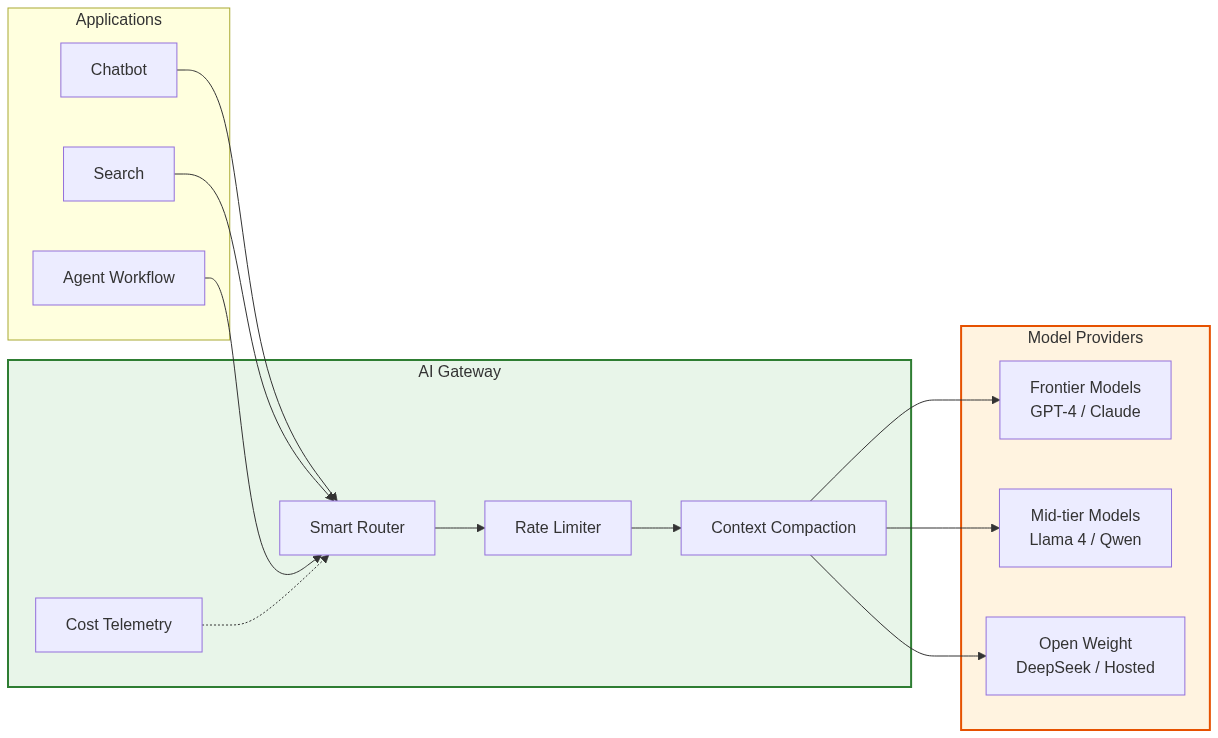
An AI gateway is an infrastructure layer that sits between your applications and your LLM providers. Instead of every application calling OpenAI, Anthropic, or other providers directly, all requests route through a single gateway that handles routing, cost control, governance, and observability.
Think of it the way a load balancer works for web traffic. You do not send every user request to a single server. You route based on capacity, cost, and health. An AI gateway does the same thing for LLM requests.
The core functions of an AI gateway include:
The per token pricing model has a structural problem. Every variable pushes costs up, not down.
Here is what happens inside a typical enterprise AI deployment over six months:
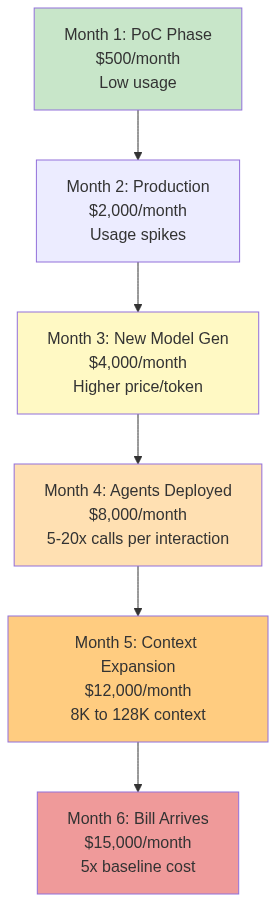
Shopping for cheaper models addresses one variable: price per token. It does not address the other four:
The teams getting ahead of this are not shopping for cheaper tokens. They are changing the plumbing.
Smart routing is the single most effective lever for cutting LLM costs. The concept is straightforward: not every request needs the most expensive model.
A request to summarize a short internal document does not need a frontier model. A request to generate a SQL query from natural language does not need a frontier model. A request to classify a support ticket does not need a frontier model. But all of these requests, if sent to a frontier model, are priced as if they do.
Shakudo's AI Gateway routes 60 to 80 percent of requests to more affordable models based on:
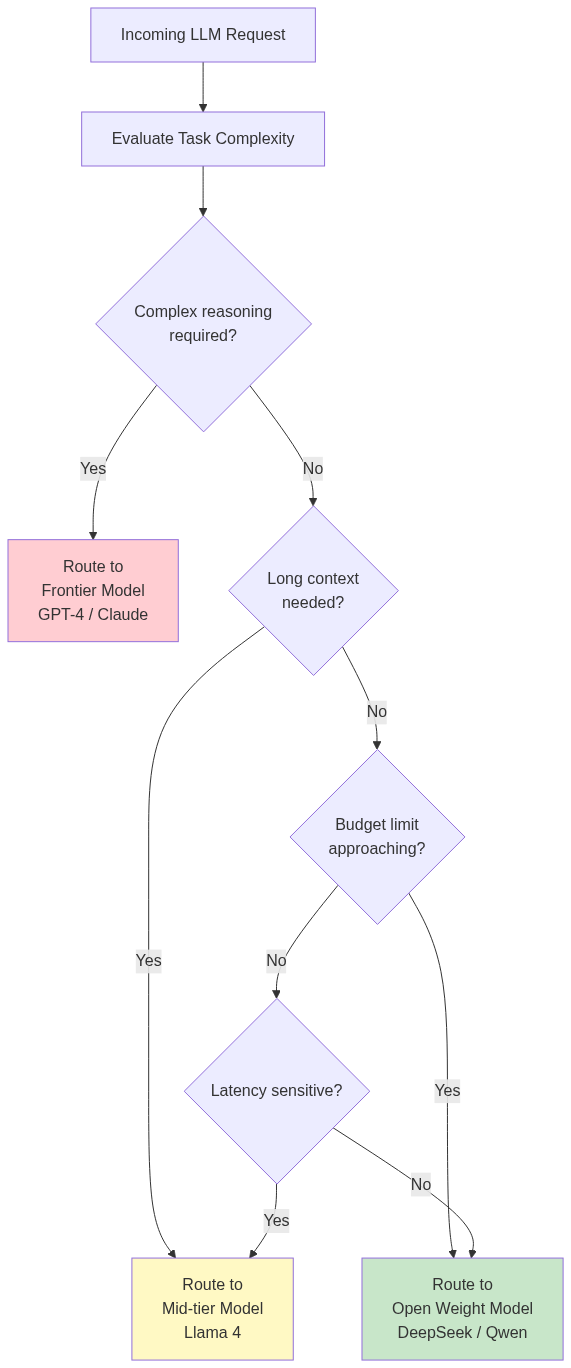
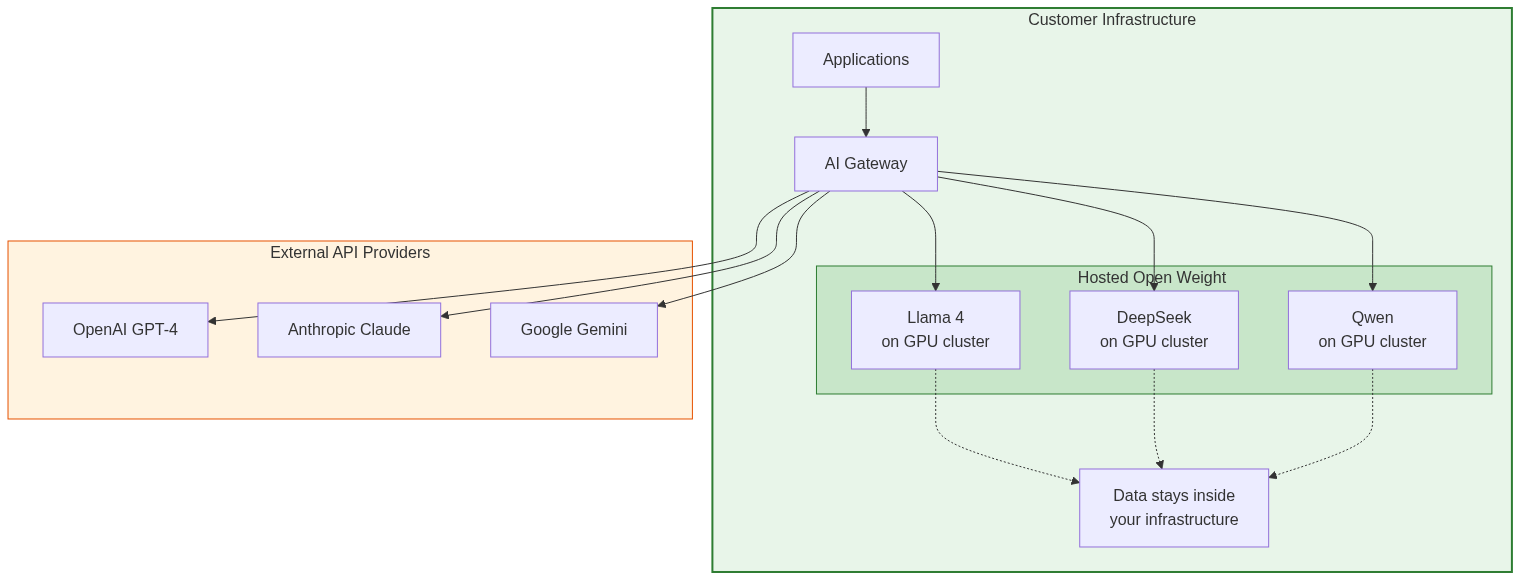
The models available through the gateway include frontier options from OpenAI GPT 4, Anthropic Claude, and Google Gemini, as well as open weight models like Llama 4, DeepSeek, and Qwen that can be hosted inside your own infrastructure.
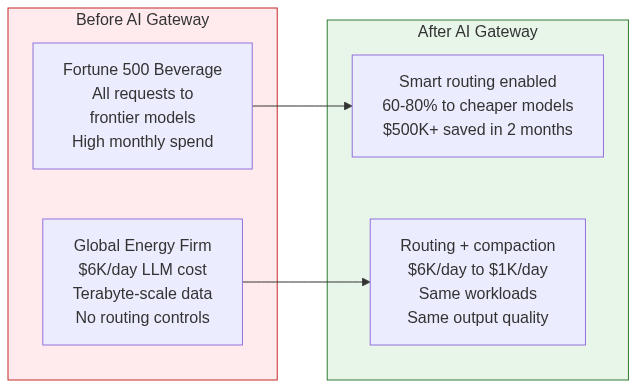
A Fortune 500 beverage manufacturer was spending heavily on frontier model API calls. Every internal tool, every chatbot, every search query was hitting the most expensive model. When they routed through an AI gateway with smart routing enabled, over $500K was saved in under two months.
The key insight: most of their requests were simple. Document search, internal Q&A, classification tasks. These did not need frontier model reasoning. The gateway routed them to more affordable models automatically. The frontier model was reserved for the tasks that actually required it.
A global energy firm had a similar experience. Their data platform was generating $6K per day in LLM costs processing terabyte scale drilling and production data. With smart routing through the gateway, that dropped to $1K per day. Same workloads, same output quality, one sixth the cost.
| Scenario | Direct API (Frontier Only) | AI Gateway (Smart Routing) | Savings |
|---|---|---|---|
| 1M requests/month, mixed complexity | $12,000 | $4,200 | 65% |
| 500K requests/month, simple tasks | $6,500 | $1,800 | 72% |
| 2M requests/month, agent workloads | $28,000 | $9,500 | 66% |
| 100K requests/month, long context | $3,200 | $1,400 | 56% |
These are illustrative figures based on typical routing patterns. Actual savings depend on your traffic mix, but the pattern is consistent: routing 60 to 80 percent of requests to cheaper models cuts total spend by 50 to 70 percent.
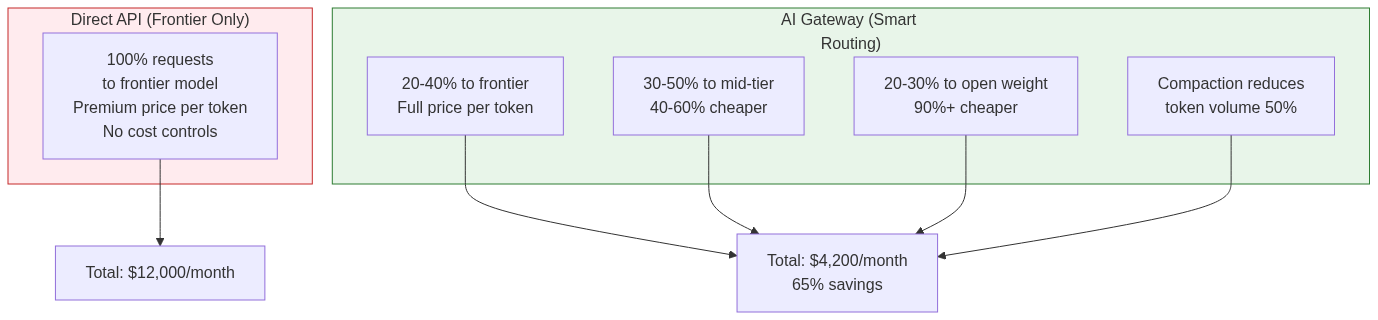
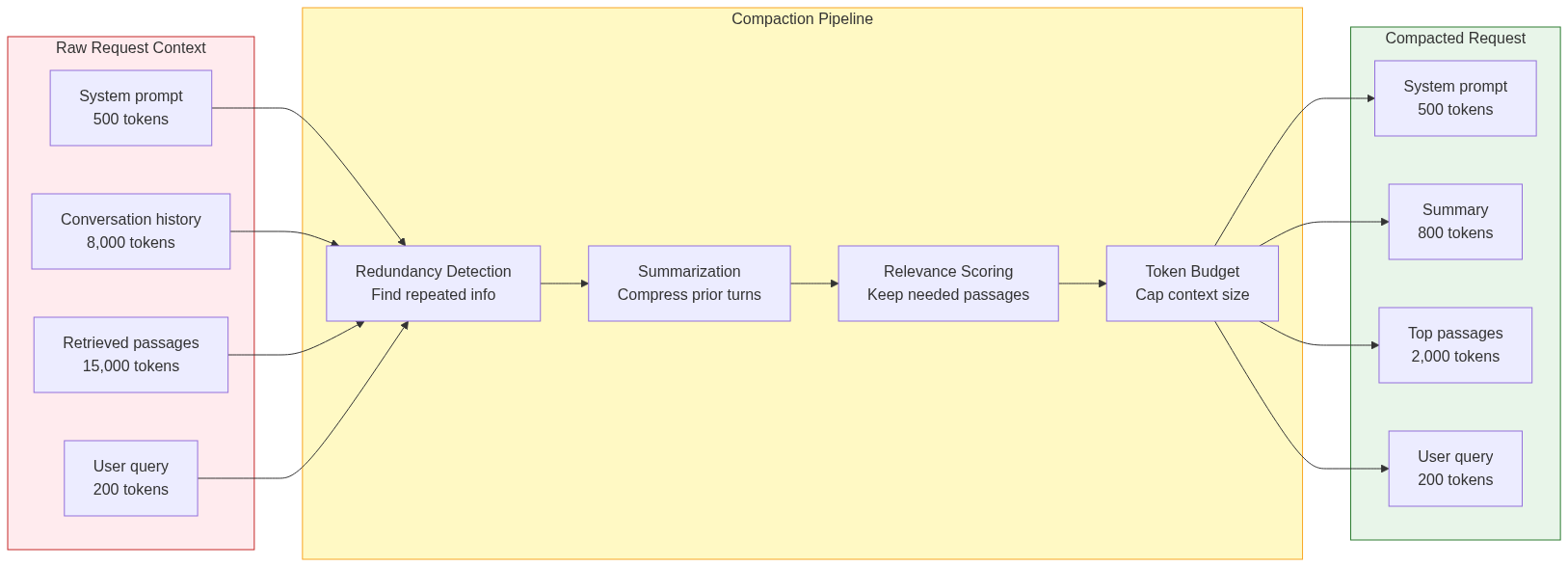
Smart routing handles which model gets the request. Context compaction handles how much token volume each request carries.
Every LLM request includes context. For a simple chat, that might be a few hundred tokens. For an agent working through a multi step workflow, it can be tens of thousands. For a retrieval augmented generation pipeline pulling from a large document set, it can be over 100K tokens.
The problem: most of that context is redundant. Previous turns of conversation, boilerplate system prompts, retrieved passages that overlap with each other. The model processes all of it, and you pay for all of it.
Continuous context compaction, a feature of Kaji, reduces the token volume of each request by removing redundancy while preserving the information the model needs to respond accurately.
In one deployment, compaction reduced OpenAI token costs by 50 percent the day it was enabled. The requests got shorter. The responses stayed the same quality. The bill dropped by half overnight.
Most AI gateway providers charge a markup on token costs. You pay the lab's price, plus a percentage. The gateway becomes another layer of margin on top of an already expensive resource.
Shakudo's AI Gateway applies zero markup on token costs. The price you pay is the price the lab charges. No intermediary margin, no volume fees, no hidden surcharges.
This matters because the markup compounds with usage. A 15 percent markup on $10K per month is $1,500. Over a year, that is $18,000 paid to the gateway provider on top of the actual model cost. At $50K per month in token spend, a 15 percent markup costs you $90,000 per year.
| Pricing Model | Monthly Token Cost | Gateway Fee | Total Monthly Cost | Annual Overhead |
|---|---|---|---|---|
| Zero markup (Shakudo) | $20,000 | $0 | $20,000 | $0 |
| 10% markup competitor | $20,000 | $2,000 | $22,000 | $24,000 |
| 15% markup competitor | $20,000 | $3,000 | $23,000 | $36,000 |
| 20% markup competitor | $20,000 | $4,000 | $24,000 | $48,000 |

The CNBC segment highlighted a broader industry shift: enterprises moving toward open weight models to gain control over compute, data, and economics. This is not a fringe trend. It is a structural realignment.
Open weight models like Llama 4, DeepSeek, and Qwen now perform close enough to frontier models for most enterprise tasks. The difference in quality is measured in percentage points. The difference in cost is measured in orders of magnitude.
When you host an open weight model inside your own infrastructure:
Shakudo's Platform hosts open weight models inside customer infrastructure, with the same smart routing and governance as managed API models. The gateway treats hosted models and API models identically from the application's perspective.
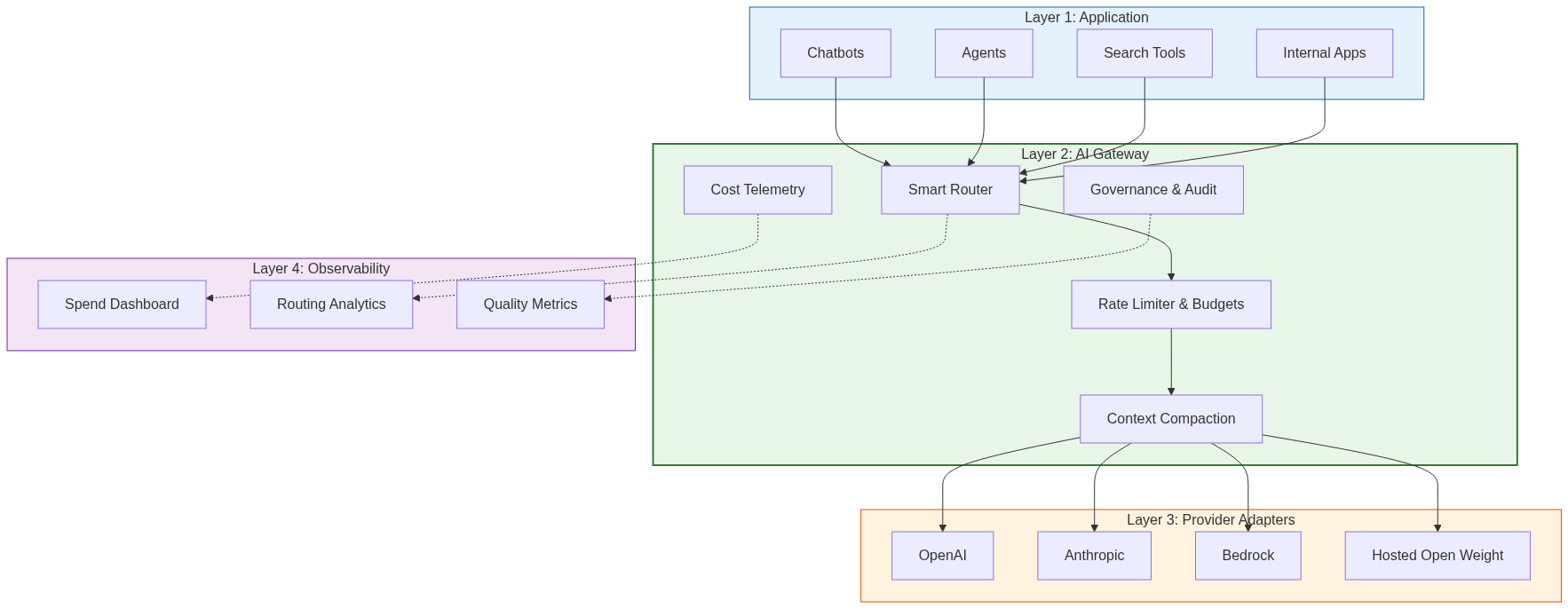
An AI gateway is not a single feature. It is a set of infrastructure capabilities that work together to control token costs across your entire AI stack.
The architecture stack includes:
If you are dealing with escalating token costs, here is the sequence that has worked for enterprises:

Agent architectures have changed the token economics equation in ways most teams do not see coming. A chatbot makes one LLM call per user message. An agent makes five, ten, sometimes twenty.
Consider a customer support agent that handles a single ticket. The workflow looks like this:
Six calls for a single ticket. At scale, that means six times the token volume of a simple chatbot doing the same job. The per ticket cost is not six times higher because each call is smaller, but the aggregate token volume is dramatically larger.
Now multiply that across thousands of tickets per day. A team processing 5,000 tickets daily with an agent workflow generating 6 calls each is making 30,000 LLM calls per day. If each call averages 2,000 tokens in and 500 tokens out, that is 75 million tokens per day. At frontier model pricing of roughly $15 per million output tokens and $5 per million input tokens, the daily cost exceeds $500. Monthly, that is over $15,000 for a single use case.
Smart routing changes this math. If 70 percent of those 30,000 daily calls are simple classification, summarization, or sentiment tasks that can be handled by a more affordable model at one tenth the cost, the daily spend drops from $500 to under $200. That is $9,000 saved per month on a single agent workflow.
Some teams try to solve this manually. Developers pick which model to use for each feature. The support team uses a frontier model for drafting responses but a cheaper model for classification. The analytics team uses a mid tier model for SQL generation. This works for a week, then breaks down.
The problems with manual model selection are predictable:
An AI gateway with smart routing solves all of these. The router evaluates every request in real time and selects the optimal model based on current pricing, current model capabilities, and the specific requirements of the request. When a model degrades or a new one ships, the router adjusts automatically. No manual intervention required.
Routing and compaction handle the supply side of token economics. Governance handles the demand side.
Without governance, any developer can spin up an LLM backed feature and start spending. There is no budget enforcement, no spend alerting, no per team visibility. The first time finance sees the cost is when the monthly invoice arrives.
An AI gateway adds governance controls that prevent cost surprises:
When you deploy an AI gateway with smart routing, context compaction, and governance, the results are measurable. Here is what a healthy deployment looks like after 90 days:
The combination of these metrics translates to real dollar savings. For a mid size enterprise spending $50K per month on LLM APIs, a 60 percent reduction means $30,000 saved monthly. Annually, that is $360,000 redirected from token costs to product development.
The point is not that AI becomes cheap. The point is that AI becomes predictable, controllable, and accountable. That is what enterprises need. Not cheaper tokens, but better economics.
Token pricing fatigue is not a passing complaint. It is a structural problem with the per token pricing model. Every model generation makes it worse. Every agent deployment multiplies it. Every context window expansion amplifies it.
The teams solving this are not shopping for cheaper models. They are changing the infrastructure layer. Smart routing, context compaction, zero markup, and open weight model hosting together cut enterprise LLM costs by 60 to 80 percent without sacrificing output quality.
If your token bill is growing faster than your AI usage, the problem is not the models. It is the plumbing.
Want to see how this works for your specific workloads? Talk to the Shakudo team about deploying an AI gateway with smart routing, zero markup token pricing, and open weight model hosting inside your infrastructure.